Did you know that a good sampling method can really help research? A study found that poor sampling can lead to incorrect conclusions in up to 70% of cases.
Cluster sampling is a useful tool in research. It divides the population into groups and randomly selects groups. This is beneficial when it is difficult or too expensive to obtain data from everyone.
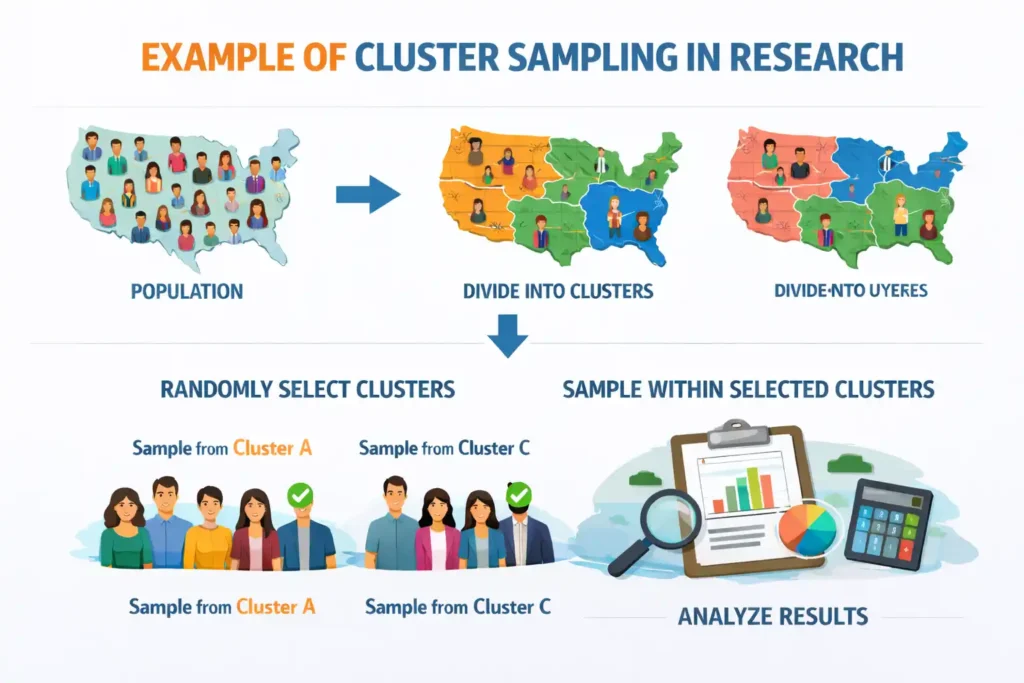
I will show you how to use cluster random sampling. We will use Eco R Stats to make it easier. By the end of this chapter, you will know how to use this method in your research.
Key Takeaways
- Understand the definition and importance of example of cluster sampling in research.
- Learn how to effectively divide the population into clusters.
- Discover how to use Eco R Stats to implement cluster random sampling.
- Gaining insights into the practical applications of cluster sampling.
- The benefits and possible challenges of this sampling method were explored.
What Is Cluster Random Sampling
In research, cluster random sampling picks groups instead of one person at a time. It is good for studying groups that are spread out or already grouped together.
Definition and Core Concepts
This method divides the population into groups and then randomly selects some of these groups. These groups are often based on where people live or work, such as schools or hospitals. The idea is that these groups show what the entire population is like.
When to Use This Sampling Method
Cluster random sampling is used when the population is large and difficult to reach. It is also good when money is tight, as it allows you to focus on certain groups. It is perfect for studying groups that already exist.
The Fundamentals of Cluster Random Sampling
Cluster random sampling is key to good research. It divides the population into groups. It then randomly selects some groups for the study.
Key Terminology You Need to Know
To obtain cluster random sampling, some terms must be known. Clusters are groups that are different internally but show the whole population. The sampling frame is a list used to select clusters. Knowing these terms helps in creating a good cluster sampling plan.
The Sampling Framework
The sampling framework is crucial. This is a list of all population clusters. For example, schools might be clusters in educational studies.
| Cluster ID | Cluster Name | Population Size |
| 1 | School A | 500 |
| 2 | School B | 600 |
| 3 | School C | 700 |
A strong and trustworthy research is based on a well-known and well-used sampling framework.
Advantages of Cluster Random Sampling
Cluster random sampling is very good for obtaining data. It is efficient and easy to use. This makes it a popular choice among researchers.
Cost and Time Efficiency Benefits
This method saves time and money. It focuses on certain groups, thereby simplifying the process. For example, conducting surveys in set areas reduces travel costs and time.
| Benefits | Description |
| Reduced Travel Costs | By sampling within clusters, researchers minimize the need for extensive travel. |
| Increased Efficiency | Data collection becomes more streamlined as efforts are concentrated within selected clusters. |
Geographical and Logistical Advantages
It also aids in geography and planning. This makes studying large or spread-out groups easier. By dividing the population into clusters, studies can be well-organized and complete.
Limitations and Potential Biases
Cluster random sampling has its advantages and disadvantages. It is important for researchers to be aware of these factors. This knowledge helps them to use this method effectively.
Sampling Error Concerns
One major problem with cluster random sampling is the increased sampling error. This is because people in a cluster might be more similar than those in other clusters. For example, if schools are the clusters, students in one school might not show what most people are like.
| Source of Error | Description | Impact on Research |
| Cluster Similarity | Individuals within a cluster are more similar | Less representative sample |
| Sampling Method | Random sampling of clusters | Potential for bias if clusters are not heterogeneous |
Homogeneity Issues Within Clusters
Another concern is the homogeneity of the clusters. If the clusters are too similar, they do not show the entire picture. For instance, a survey on shopping habits might miss the mark if it only looks at one area with a specific group of people.
To address these problems, researchers must carefully consider how they create clusters. They should attempt to make the clusters as different as possible. This may involve breaking the population into smaller groups or using more clusters.
Step-by-Step Guide to Implementing Cluster Random Sampling
Breaking down cluster random sampling into steps helps researchers obtain reliable results. This guide describes how to do this well.
Defining Your Research Objectives
The first step is to clearly define the research goals. You must know your research question, study scope, and population. Clear goals help in designing a focused sampling strategy.
Identifying and Creating Appropriate Clusters
After setting your goals, find and create good clusters. Clusters must be separate and cover the entire population. Eco R Stats can help organize and analyze clusters. An example of a cluster organization is as follows:
| Cluster ID | Description | Population Size |
| 1 | Urban Area 1 | 1000 |
| 2 | Rural Area 1 | 800 |
| 3 | Urban Area 2 | 1200 |
Selecting Clusters Randomly
Next, the clusters are randomly selected. A random method was used to choose the clusters in the sample. Random selection reduces bias and makes the sample representative of the population. The following is an example of a random selection.
By following these steps, researchers can use cluster random sampling effectively. This is great for large studies where simple random sampling is difficult.
Example of Cluster Sampling In Research
Example 1. School-Based Vaccination Coverage Study
Scenario: A state health department wants to assess the vaccination rates among elementary school children across 500 schools.
Implementation:
- Population: All elementary students in 500 schools statewide
- Clusters: Individual schools (each school = one cluster)
- Sampling process: Randomly select 50 schools from the list of 500
- Data collection: Survey ALL students within the 50 selected schools about their vaccination status
Why cluster sampling? Visiting all 500 schools is prohibitively expensive and time-consuming. By selecting complete schools as clusters, researchers can collect comprehensive data from fewer locations while maintaining geographic and demographic diversity.
Practical advantage: Researchers can coordinate with school administrators at 50 locations rather than trying to reach scattered, individual students across 500 schools.
Example 2: Customer Satisfaction Survey for a Retail Chain
Scenario: A national retail company with 300 stores wants to measure customer satisfaction.
Implementation:
- Population: All customers shopping at 300 store locations
- Clusters: Individual store locations
- Sampling process: Randomly select 40 stores from different regions
- Data collection: Interview customers at the selected stores over a specific week
Why cluster sampling? Sending surveyors to every store is logistically complex and costly. Clustering by store location allows the company to concentrate its resources while capturing regional variations in customer experience.
Additional consideration: Stratification could be added by ensuring that stores are selected proportionally from urban, suburban, and rural areas.
Example 3: Healthcare Access Study in Rural Villages
Scenario: An international NGO wants to study healthcare access in a region with 200 rural villages.
Implementation:
- Population: Households across 200 villages
- Clusters: Villages (geographic communities)
- Sampling process: Randomly select 25 villages
- Data collection: Conduct household surveys in ALL households within the 25 selected villages
Why cluster sampling? Rural villages are often geographically dispersed and have poor infrastructure. Traveling to all 200 villages would require enormous amounts of time and resources. By selecting complete villages, the field teams can conduct thorough assessments in concentrated areas.
Practical benefit: Teams can stay in selected villages for several days, building rapport with community members and ensuring high response rates, which would not be feasible if they were trying to reach scattered households across all villages.
Example 4: Employee Workplace Safety Assessment in Manufacturing
Scenario: A large manufacturing corporation with 80 factory facilities wants to evaluate its workplace safety practices.
Implementation:
- Population: All employees across 80 manufacturing plants
- Clusters: Individual factory facilities
- Sampling process: Randomly select 15 factories
- Data collection: Interview all employees and inspect all work areas at the 15 selected facilities
Why cluster sampling? Manufacturing facilities are often spread across different states and countries. A complete safety audit requires on-site inspection of equipment, practice observation, and face-to-face interviews. Clustering by facility makes this assessment feasible.
Cost efficiency: Instead of partial inspections at all 80 facilities, auditors can conduct thorough multi-day assessments at 15 locations, resulting in richer data and lower travel costs.
Example 5: Housing Quality Survey in Urban Neighborhoods
Scenario: A city housing authority wants to assess the housing conditions across 150 city blocks in a metropolitan area.
Implementation:
- Population: All residential units across 150 city blocks
- Clusters: City blocks (geographic units)
- Sampling process: Randomly select 30 city blocks from different districts
- Data collection: Inspect ALL housing units on the 30 selected blocks
Why cluster sampling? Housing inspections require physical visits and detailed assessments of the housing. The inspection of scattered individual units across 150 blocks would involve constant travel between locations. By selecting entire blocks, inspectors can work efficiently in concentrated areas.
Practical advantage: Inspectors can walk from building to building on selected blocks, dramatically reducing transportation time and costs while still capturing the variation across different neighborhoods and socioeconomic areas.
Case Study: Educational Research Survey
This survey was conducted in many school districts. It examined how a new teaching method affected students. Schools were randomly chosen to ensure a fair sample. Thus, researchers can obtain data more easily and accurately.
| School District | Number of Schools | Sample Size |
| District A | 10 | 5 |
| District B | 15 | 7 |
| District C | 8 | 4 |
Implementation Process and Results
First, the researchers selected the school districts to study. They then randomly chose schools to participate. Every student in these schools was surveyed, providing a large dataset for analysis.
The survey found significant gains in student success when the new teaching method was used. Cluster random sampling showed how well the program worked at the school level. This would not have been possible using other methods.
The success of this survey demonstrates the value of cluster random sampling in education. I hope this example helps demonstrate its benefits for future studies.
Statistical Formulas and Calculations
Knowledge of statistical formulas is key to cluster random sampling. They help to determine the appropriate sample size and estimate the variance.
Sample Size Determination
Finding the appropriate sample size is crucial. The sample size calculation considered the number of clusters and elements in each. The formula used is the design effect, which shows how clustering affects the variance. It is calculated as Deff = 1 + (m-1)ρ, where m is the average cluster size and ρ is the intra-cluster correlation coefficient.
Several factors affect the size of the sample.
- The precision needed in the estimates
- The expected variance within and between clusters
- The study’s resources
Variance Estimation in Cluster Sampling
Variance estimation is also important. The cluster sampling formula for this study examines the variability in and between clusters. Getting the variance right is key to making good guesses about the entire population.
- Make sure clusters are like the population
- Use good software for hard calculations
- Remember the design effect in your analysis
By using these statistical formulas for cluster sampling, researchers can make their studies more valid and reliable.
Cluster Random Sampling vs. Other Sampling Methods
It is crucial to understand the differences between various sampling methods. Cluster random sampling has its own advantages and disadvantages compared to other sampling methods.
Comparison with Stratified Random Sampling
Cluster random sampling and stratified random sampling aim to obtain representative samples. However, they approach this differently. Stratified sampling splits the population into groups and samples each group.
In contrast, cluster sampling selects groups or clusters for sampling. It does not focus on individual observations.
| Characteristics | Cluster Random Sampling | Stratified Random Sampling |
| Population Division | Divided into clusters | Divided into strata |
| Sampling Unit | Clusters | Individuals within strata |
| Precision | Generally less precise | More precise due to stratification |
When to Choose Cluster Over Simple Random Sampling
Cluster random sampling is useful when the population is spread over a large area. Simple random sampling may be too expensive or difficult to perform in such cases.
It is also good when you cannot obtain a list of the entire population. However, lists of clusters can be obtained.
Knowing the advantages and disadvantages of cluster random sampling helps researchers select the best method for their study.
Analyzing Data from Cluster Samples
When analyzing data from cluster samples, careful consideration is required. This is because the data have a special structure. Observations in each cluster were more similar than those in other clusters.
Accounting for Cluster Effects
To obtain the most from cluster sampling data, we must consider the cluster effects. We used special methods, such as mixed-effects models or generalized estimating equations (GEE). This helps us better understand the data and avoid mistakes.
Interpreting Results Accurately
When analyzing cluster sampling data, we must pay close attention to the cluster effects. It is not only about the numbers. We also need to determine how clusters add to the variety of data.
In this way, we can ensure that our conclusions are correct. We can make better choices based on our findings.
Common Mistakes and How to Avoid Them
Cluster random sampling has its advantages. However, this can also lead to mistakes. These errors can affect the trustworthiness of the research.
Design Flaws in Cluster Sampling
One major mistake is creating incorrect clusters. The clusters must be mutually exclusive and collectively exhaustive. This means that every person or thing should only be in one cluster.
- Ensure that the clusters are the same inside but different from each other.
- Do not make clusters too large or small. This can cause problems or unfairness.
Analysis Errors and Their Solutions
When analyzing, forgetting the cluster design is a common mistake. This can result in incorrect variance estimates. This affects the accuracy of the study.
- Use the correct statistical methods to obtain the cluster design.
- Try bootstrapping or jackknife resampling to obtain the correct variance.
Conclusion
Cluster random sampling is an excellent method for conducting research. This saves time and money, making it ideal for large studies. By knowing the benefits of cluster random sampling, researchers can improve their studies.
An example of cluster random sampling in school studies is as follows. Schools were selected as the groups. In this way, researchers can obtain data from a large group, helping them to understand more.
When using cluster sampling in research, selecting the appropriate groups is crucial. This ensures that the data are good and true. This helps avoid mistakes in the study.
In summary, cluster random sampling is very useful for research. Using Eco R Stats makes this process easier. With this method and the right tools, researchers can obtain great data and make smart choices.
FAQ
What is cluster random sampling
Cluster random sampling divides the population into groups. Then, it randomly selects some of these groups for the study.
When should cluster random sampling be used?
It is used when the population is spread over a large area. It is also good when making a complete list of the population is difficult or expensive.
What are the advantages of cluster random sampling?
This saves time and money. It is also easier to manage because of its focus on geographical areas. This makes it a good choice for many applications.
What are the limitations of cluster random sampling?
This can lead to errors in the sample. In addition, the groups might be too similar, which can make the results less accurate.
How do I implement cluster random sampling?
First, determine what you want to study. Then, groups are formed based on the research. Pick groups randomly. Tools such as Eco R Stats can assist with this.
How do I determine the sample size for cluster random sampling?
To determine the appropriate sample size, consider the design effect. This effect shows how clustering changes the accuracy of the sample.
What is the design effect of cluster sampling?
The design effect shows how clustering affects the variance of the sample. It is key to determining the sample size.
How do I analyze data from cluster samples?
When looking at cluster sample data, the cluster effect should be considered. This helps you to better understand the results.
What are the common mistakes in cluster sampling?
Mistakes include poor cluster design and ignoring the cluster effect in the analysis. This can disrupt your study.
How can mistakes in cluster sampling be avoided?
Carefully plan and define the clusters. The appropriate statistical methods were used to handle the cluster effect.
What is the role of Eco R Stats in cluster-random sampling?
Eco R Stats helps a lot with cluster sampling. It offers tools, examples, and ways to clearly view data.
How does cluster random sampling compare with other sampling methods?
Cluster sampling has its pros and cons compared to other methods. The best choice depends on the study goals and design.
Read more