
Did you know that nearly 70% of research studies in the social sciences use non-probability sampling methods? Convenience sampling is one of the most common sampling methods.
As a researcher, I have learned that convenience sampling is a quick and easy way to obtain data. This allows us to gather data from people who are easy to find.
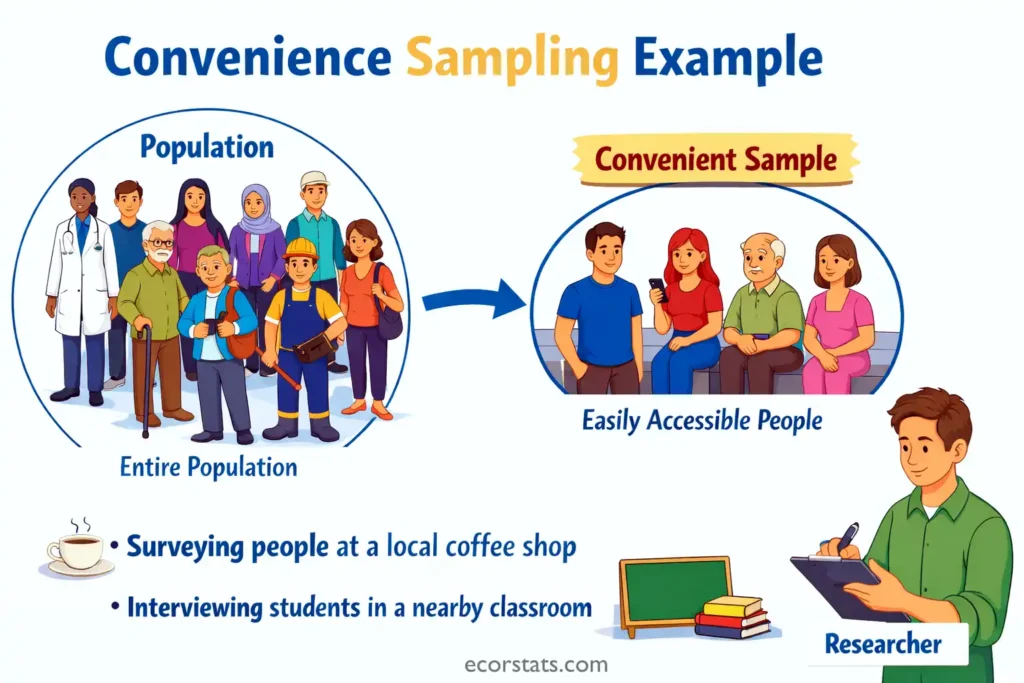
Understanding how convenience sampling example works helps researchers make smart choices. This ensures that their studies are both quick and effective.
Key Takeaways
- Convenience sampling is a non-probability sampling method that involves collecting data from easily accessible participants.
- This method is widely used in research because of its practicality and cost-effectiveness.
- Understanding convenience sampling is key to making smart choices in research.
- Using convenience sampling means considering its good and bad points.
- Researchers can use convenience sampling in many ways to achieve their study goals.
Understanding Convenience Sampling
As a researcher, knowledge of convenience sampling is key. This is a non-probability sampling method. Participants were selected because they were easy to reach.
Definition and Core Concepts
Convenience sampling involves obtaining data from people who are easy to find. It is used when time or money is tight. The definition of convenience sampling shows that it is simple and handy.
Where Convenience Sampling Fits in Research Methodology
Convenience sampling is a research sampling technique. This is beneficial for quick studies or when resources are scarce. Knowing its place in research is vital for a good study design.
Types of Convenience Sampling
There are many types of convenience sampling methods. For example, consecutive and self-selective sampling. Consecutive sampling obtains all participants within a set time. Self-selective sampling allows people to choose to join.
Understanding these types helps researchers decide when to use convenience sampling.
When to Use Convenience Sampling in Your Research
Convenience sampling is useful when data are required quickly. It is perfect for quick studies. This method helps obtain data quickly and easily.
Ideal Research Scenarios
It is easy to use in exploratory research or pilot studies. It is good for obtaining first ideas or testing a large study.
Time and Budget Constraints
When you are short on time and budget, it is a smart choice. This saves time and money. You do not require many resources.
| Research Constraint | Convenience Sampling Advantage |
| Time Constraints | Quick data collection |
| Budget Constraints | Cost-effective |
Preliminary or Exploratory Studies
It is the top choice for preliminary or exploratory studies. This helps identify trends and formulate better questions. Subsequently, a larger study can be conducted.
Knowing the advantages and disadvantages of convenience sampling is helpful. You can decide when to use it wisely in your study.
Step-by-Step Guide to Implementing Convenience Sampling
Convenience sampling is key to good research. Although simple, it requires careful planning. This ensures that your data are useful and meet your research goals.
Defining Your Research Objectives
Start by setting clear goals for your research project. It is important to know what you want to find out and what questions to ask. Clear objectives help guide sampling and keep data focused.
Identifying Your Accessible Population
Then, identify a group that can be easily reached. These may be students, patients, or customers. Select a group that fits your research and is easy to access.
Determining Sample Size
Choosing an appropriate sample size is important. You do not need a huge sample, but a sufficiently large one makes your results more reliable. Consider your research and the extent of your capabilities.
Creating Your Sampling Plan
A sampling plan was developed to show how the data were obtained. It should state how surveys or interviews will be used and how people will be found to talk to. A good plan helps in dealing with any problems that may arise.
| Step | Description | Considerations |
| 1. Define Research Objectives | Clearly outline what you aim to achieve | Ensure objectives are specific and measurable |
| 2. Identify Accessible Population | Determine who is easily accessible to you | Consider relevance to your research objectives |
| 3. Determine Sample Size | Decide on the number of participants needed | Balance between having enough data and resource constraints |
| 4. Create Sampling Plan | Outline your data collection strategy | Choose appropriate data collection methods |
By following these steps and considering your research, you can effectively use convenience sampling. This will help you gain valuable insights.
Convenience Sampling Example: Case Studies from Different Fields
Convenience sampling is used in various fields. It is flexible and useful in various research areas.
Academic Research Examples
It is easy to use in schools. For example, a study on online learning might select students from one university or class. This provides insights into their online learning experiences.
Market Research Applications
Market researchers often choose it for quick data. For instance, a company might ask customers at a store about their shopping habits.
Healthcare Studies Using Convenience Sampling
In healthcare, it is used when time and money are limited. Researchers may ask patients at a clinic about their health or satisfaction.
Social Science Research Examples
Social scientists also use it. For example, a researcher might ask people at a community event about their views or behaviors on a specific topic.
| Field of Research | Example of Convenience Sampling | Benefits |
| Academic Research | Surveying students at a university | Easy access to participants, quick insights |
| Market Research | Surveying customers at a store | Immediate feedback, cost-effective |
| Healthcare Studies | Surveying patients at a clinic | Rapid data collection, relevant to specific patient groups |
| Social Science Research | Surveying attendees at a community event | Accessible population, diverse data |
These examples show the wide-ranging nature of convenience sampling. It is a handy tool for many types of research.
Benefits of Convenience Sampling for Researchers
Researchers choose convenience sampling for its quick and reliable results. It does not require many resources. This method is popular in many research areas because of its advantages.
Time Efficiency Advantages
Convenience sampling allows researchers to obtain data quickly. This is advantageous when time is limited. It uses people who are easy to find, thus speeding up the data collection process.
Cost-Effectiveness Benefits
Convenience sampling is also cost effective. It does not require a lot of money to find participants. This makes it suitable for researchers with small budgets.
Accessibility and Ease of Implementation
Convenience sampling is easy to use. Researchers can find and recruit people nearby, such as students or patients. This makes it simpler than other methods.
Quick Preliminary Insights
It also provides quick insights into research topics. Researchers can obtain data quickly and test ideas. This is important for initiating research.
In summary, convenience sampling is advantageous because of its speed, cost savings, and ease. It helps researchers in many fields gain quick insights.
Overcoming Limitations of Convenience Sampling
Convenience sampling has its downsides, such as selection bias and not being truly representative of the population. However, with careful planning, these issues can be addressed. This method is easy and inexpensive to use, but it has its flaws.
Addressing Selection Bias
Selection bias is a major problem with convenience sampling. This can make our sample not truly show what the whole group is like. To address this, we used stratified sampling in our convenience sample. This helps ensure that all parts of the group are well represented.
Enhancing Representativeness
To make our sample more like the real group, we need to be clear about who we want. Participants who fit our target group well should be selected. In addition, quota sampling helps ensure that we have a variety of people in our sample.
Combining with Other Sampling Methods
Using other methods with convenience sampling can help to address these problems. For example, adding purposive sampling can ensure that we obtain people with the right traits for our study. This mix can strengthen our research.
Transparency in Reporting Limitations
It is key to be open about the limitations of convenience sampling. We should clearly state the biases and limitations of our method in our report. This openness helps others understand the strengths and weaknesses of our study.
By using these strategies, we can improve our research. We can ensure that our findings are reliable and valid.
Comparing Convenience Sampling vs. Random Sampling
It is crucial to understand the difference between convenience and random sampling for good research. As a researcher, selecting the appropriate method depends on your goals, resources, and the required accuracy of your results.
Convenience sampling selects participants who are easily found. Random sampling randomly selects participants from the entire group.
Key Differences in Methodology
The main difference is in how the participants are selected. Convenience sampling is non-probability sampling, picking based on who’s easy to find. Random sampling is a probability sampling method in which all individuals have an equal chance of being selected.
When to Choose One Over the Other
The choice depends on the research goals and what can be achieved. Convenience sampling is good for exploratory studies or when one is short on time and resources. Random sampling is better when high accuracy and representativeness are required.
Hybrid Approaches for Better Results
Using bits from both methods can improve research. For example, convenience sampling can be used for a pilot study. Subsequently, random sampling was used for the main study.
Impact on Research Validity
The method chosen affects the validity of the research. Random sampling usually provides more reliable results because it reduces bias. However, convenience sampling can also provide useful insights if used correctly.
Data Collection Strategies for Convenience Samples
To obtain the most from convenience sampling, we need good data collection plans. This means using well-designed surveys, the right interview methods, and digital tools to make things easier.
Survey Design Considerations
Survey design is key to collecting data for convenience sampling. Questions should be clear and concise. It is also prudent to test surveys first to fix any problems before using them for real.
Interview Techniques for Convenience Samples
The manner in which we conduct interviews is important. For convenience sampling, semi-structured interviews are effective. They allowed us to be flexible while keeping our main questions in mind. It is important to train our interviewers well to keep things consistent and fair.
Digital Tools for Efficient Data Collection
Digital tools can make data collection faster and more accurate. We can use online survey sites, mobile data apps, and social media to reach more people quickly. These tools also help us clean and analyze our data.
Ensuring Data Quality Despite Sampling Limitations
Even with the limitations of convenience sampling, we can ensure that our data are good. We do this by carefully checking and cleaning our data. It is also key to be open about how we obtained our data and any possible biases when we share our results.
| Data Collection Method | Advantages | Challenges |
| Surveys | Cost-effective, quick to administer | Response bias, limited depth |
| Interviews | In-depth insights, flexibility | Time-consuming, interviewer bias |
| Digital Tools | Efficient, wide reach | Technical issues, data security concerns |
Analyzing and Reporting Convenience Sampling Results
When analyzing and reporting on convenience sampling, a few things need to be balanced. You must be careful and honest in your methods. This helps obtain useful insights from the data.
Statistical Considerations
Statistical considerations are key when working with convenience sample. You should select the appropriate statistical methods for your questions and data. For example, simple statistics might be used to describe the sample. However, you should be careful when making bigger claims because of the sample’s limits.
Acknowledging Limitations in Your Analysis
It is important to discuss the limitations of convenience sampling. You should be open about any biases and how sampling affects your results. This way, you can share your findings in a clear and honest manner.
Presenting Findings with Appropriate Context
When sharing your findings, consider where and how you obtained your data. Give enough background so people understand your data’s value and limits. Use simple language and images to explain your results.
Ethical Reporting of Convenience Sample Data
Ethical reporting is important for convenience samples. You should always be truthful about your methods, limitations, and any biases. Do not make your results seem more general than they are. Be open about what your sample can and cannot tell you.
In short, convenience sampling is complex. You must consider statistics, limits, and ethics. By doing this, you can share your results in a clear, honest, and useful way.
- Be open about your sampling method and its limitations.
- Choose the right statistical methods for your data.
- Share your findings clearly with context and bias awareness.
- Reports should be ethical and avoid broad claims.
Conclusion: Making the Most of Convenience Sampling in Your Research
Convenience sampling is a great way to obtain quick and useful results. It is good for starting studies or getting a first look at something. It is used in many areas, such as schools, market research, and health studies.
It is fast and inexpensive, which is why it is popular. However, it iss not perfect. It may miss some groups of people.
To get the best results from it, be aware of its downsides. Subsequently, it was mixed with other methods. This makes the findings stronger and more reliable.
In summary, convenience sampling is very useful. It provides good insights when used correctly. Understanding its strengths and weaknesses can help researchers improve their work quality.
FAQ
What is convenience sampling, and how does it differ from other sampling methods?
Convenience sampling selects individuals based on their accessibility. This is different from random sampling because it does not attempt to cover the entire group.
What are the benefits of using convenience sampling in research?
This saves time and money. This is good for quick studies. Thus, researchers can obtain fast insights without spending much.
What are the limitations of convenience sampling, and how can they be addressed?
This may not be fair or fully representative of everyone. To address this issue, we combined it with other methods. In addition, be open about its limits and try to make it fairer.
How do I determine the appropriate sample size for convenience sampling?
Consider what you want to learn, who you can reach, and how precise you need to be. There is no exact formula, but aim for enough people to provide useful answers.
Can convenience sampling be used in conjunction with other sampling methods?
Yes, mixing it with other methods can improve the results. Thus, the best of both worlds is achieved.
How can I ensure data quality when using convenience sampling?
Ensure that your surveys and interviews are good. Digital tools can be used to collect data rapidly. Be aware of biases and try to avoid them.
What are the common applications of convenience sampling in different fields?
It is used in many areas, such as school research, market studies, health studies, and social sciences. It is easy to use and works well in many fields.
How do I report the results of convenience sampling in my research?
Always discuss its limitations and explain your findings. Be honest about the possible biases. This makes the results more reliable.
Can convenience sampling be used in both qualitative and quantitative research?
Yes, it fits both types of research methods. Its flexibility makes it ideal for many study designs.
How does convenience sampling compare with random sampling in terms of research validity?
Convenience sampling uses the researcher’s choice, whereas random sampling tries to be fair. Your choice depends on what you want to learn and what you can do with the information.
Read more


[…] Convenience Sampling […]