

I often see researchers who find examle of systematic sampling difficult to grasp. It is a way to select people from a large group at set times. This helps obtain a fair sample without talking to everyone.
This method is great for large groups. This allows researchers to obtain a good sample without talking to every person.

Systematic random sampling helps make research more accurate. This is a smart way to obtain data. This makes it useful in several research areas.
Key Takeaways
- Systematic sampling is a method of selecting people at set times.
- It is good for large groups and helps obtain a fair sample.
- This method makes research more accurate by reducing biases.
- It’s a smart way to get data.
- It is useful in many research areas, making statistics easier.
What Is Systematic Random Sampling?
Systematic sampling is useful for obtaining data from large groups. It selects every nth item from a list, starting randomly. This provides a fair picture of the entire group.
Systematic Sample Definition in Statistics
In statistics, a systematic sample is selected using a special method. The gap between picks depends on the group size and the number of samples required. This helps us understand how it differs from random or stratified sampling.
Key Characteristics of Systematic Sampling
Systematic sampling has some important characteristics. These features make it a good choice for researchers. They are:
- A fixed interval between picks, which lowers the bias.
- A random starting point was used to ensure that the sample was fair.
- Efficiency in obtaining data, as it is quicker than picking every item randomly.
Historical Development and Use
Systematic sampling has been used for decades in fields such as social sciences, medicine, and market research. It began as a method to collect data more efficiently and cost-effectively. It is now a key method in statistics.
The Importance of Systematic Sampling in Research
Systematic sampling is key to this research. This helps gather a large amount of data easily. This makes research better and faster.
Scientific Validity and Reliability
Systematic sampling ensures that research is scientifically valid. It selects samples in a set manner. This ensures that the sample is fair and true to the entire group.
Efficiency in Data Collection
Systematic sampling is highly efficient. This allows researchers to obtain data from many people without spending much. This is beneficial for studies with small budgets.
Applications Across Different Fields
Systematic sampling is effective in many areas. It is used in social science, healthcare, and market research. This is a helpful tool for many types of research.
| Field | Application | Benefit |
|---|---|---|
| Social Sciences | Studying population trends | Reliable data on demographic changes |
| Healthcare | Patient outcome analysis | Improved healthcare policies |
| Market Research | Consumer behavior analysis | Targeted marketing strategies |
When to Use Systematic Sampling
Choosing systematic sampling depends on knowing its advantages and disadvantages. It works best with large, well-organized groups.
Ideal Scenarios for Implementation
Systematic sampling is ideal for projects with clear and easily accessible groups. For example, in schools, it is good for selecting students from a list.
| Research Context | Ideal Characteristics |
|---|---|
| Large, organized populations | Known population size, easily accessible |
| Educational institutions | Student rosters, class lists |
When It’s Inappropriate to Use Systematic Random Sampling
Systematic sampling is not effective when the group has a hidden pattern. This pattern can affect the results.
Why Researchers Choose Systematic Over Purposive Sampling
Researchers prefer systematic sampling because it provides a fair sample. This helps to avoid biased choices.
In summary, systematic sampling is a good choice for researchers to consider. Knowing when and why to use it helps to make better research plans.
The Mathematics Behind Systematic Sampling
Systematic Random Sampling - Sample Selection
Your Systematic Sample:
What is Systematic Sampling?
Systematic sampling selects every kth element from a population, starting from a randomly chosen point. The sampling interval k = N/n.
How it works:
- Enter your population size (N) - the total number of items
- Enter your desired sample size (n) - how many items to select
- The system calculates the sampling interval: k = N/n
- Choose a random starting point between 1 and k
- Select every kth element: start, start+k, start+2k, etc.
Key Properties:
- Easier to execute than simple random sampling
- Provides good coverage across the population
- More efficient for large populations
- Each element has equal probability of selection (n/N)
- Watch out for periodic patterns in your data
Understanding the mathematics of systematic sampling is key to good research. This is actually quite simple.
Population Size and Sample Size Relationship
The population (N) and sample (n) sizes are linked. The sample was a part of the population. Finding the appropriate sample size is crucial for obtaining good results.
Calculating the Sampling Interval
To determine the sampling interval (k), the population size (N) was divided by the sample size (n). This indicates how often elements should be selected. For example, if N = 1000 and n = 100, k = 10. This implies selecting every 10th element.
Systematic Sampling Formula and Notation
The formula for systematic sampling is simple. First, a random start is selected from the first k elements. Then, every k-th element is selected. The formula is: r, r+k, r+2k, …, r+(n-1)k. This spreads the sample across the population.
Knowledge of these mathematical concepts helps researchers to use systematic sampling effectively. They can obtain good samples from their population.
A Comprehensive Example of Systematic Sampling
Let us consider a simple example of systematic sampling. Consider a list of 1,000 customers who purchased a product. This method is effective for obtaining a good sample from a large group.
Defining Your Population
First, we defined the population. In this example, there are 1,000 customers. It is important to know who we are studying to obtain a fair sample.
Determining Sample Size Requirements
Then, we determined how many customers were required. Suppose we want 100 customers. The number of customers we choose affects the accuracy of our results.
Calculating the Sampling Interval (k)
The sampling interval, or k, is determined by dividing the total number of customers by the number we want. So, k = 1,000 / 100 = 10. This means that we selected every 10th customer.
Selecting the Random Starting Point
To add randomness, we selected a random starting point between 1 and k (10 in our case). Let’s say it’s 7. Therefore, our first customer is the 7th one on the list.
Collecting Your Sample Elements
Starting with the 7th customer, we selected every 10th customer thereafter. This includes the 17th, 27th, and so on, until we have 100 customers. Thus, our sample covered the entire list of relevant studies.
By following these steps, systematic sampling can be performed effectively. It is great for large lists of people. It is easy and helps us obtain a fair sample, which is very useful in research.
Practical Example: Systematic Sampling in a School District
Let us examine how systematic sampling works in a school district. This is great for obtaining data quickly and accurately.
Setting Up the Sampling Frame
The first step was to set up the sampling frame. For example, if we want to study high school students, we create a list of all the students. This list helped us select the appropriate sample.
Implementing the Sampling Process
After setting up the list, we decided how many students to study. Suppose we want to study 1,000 out of 10,000 students. We then selected a starting point and chose every 10th student thereafter.
Tools such as Excel can be used to assist us. For instance, if we start with 7, we select students 7, 17, 27, and so on.
Analyzing the Results
Once we have our data, we will look for trends. For example, if we asked about favorite activities, we might find that many people like sports.
| Activity | Number of Students | Percentage |
|---|---|---|
| Sports | 450 | 45% |
| Music | 250 | 25% |
| Clubs | 300 | 30% |
Lessons Learned
This example demonstrates how systematic sampling works. This is efficient and fair. We learned the importance of a good list and the right sample size.
Systematic sampling can provide a lot of information about students. This helps us make better choices regarding schools.
Advantages and Disadvantages of Systematic Random Sampling
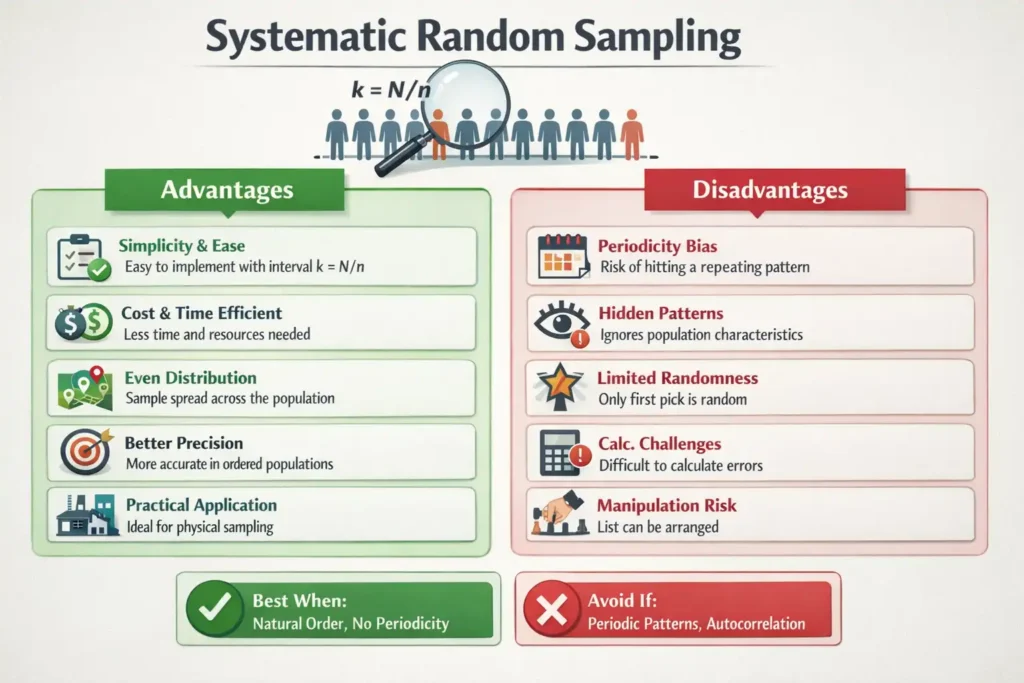
Advantages of Systematic Sampling
Systematic sampling has several benefits. It is easy to use and selects a good sample from a large group.
Simplicity and Efficiency in Implementation
One major advantage of systematic sampling is its simplicity. It uses a fixed number (k) to select samples. This makes it easy to use without requiring complicated steps.
Even Distribution Across Population
Systematic sampling ensures that everyone is included. It spreads out evenly. This helps obtain a fair sample from the entire group.
Reduced Risk of Human Selection Bias
Using a set interval helps avoid personal biases. Researchers do not select who to include in the study. This keeps things fair.
Cost-Effectiveness for Large Populations
For large groups, systematic sampling saves money. It is easy and does not require many random choices. This makes it ideal for large studies.
| Advantages | Description | Benefits |
|---|---|---|
| Simplicity | Easy to implement with a fixed interval | Reduces complexity in sampling |
| Even Distribution | Covers the entire population range | Ensures representativeness |
| Reduced Bias | Minimizes human selection bias | Enhances objectivity |
| Cost-Effectiveness | Ideal for large populations | Reduces research costs |
Disadvantages of Systematic Sampling
Systematic sampling has several disadvantages. It is not perfect for data collection. Understanding these issues helps ensure that the results are good.
Risk of Periodicity in the Data
Systematic sampling can be problematic with data patterns. If the data list has a pattern, the sample may not be fair.
Potential for Hidden Patterns to Skew Results
Hidden patterns can disrupt the results. For example, if students are listed by gender, the sample may not be balanced. This depends on the starting point and the sampling frequency.
Limitations in Certain Population Structures
Systematic sampling does not work well with certain data structures. This may have missed out on the variety in the population.
Challenges with Variance Estimation
It is difficult to determine the variance in systematic sampling. This makes it difficult to understand and use these data.
| Disadvantage | Description | Impact |
|---|---|---|
| Risk of Periodicity | Coincidence with hidden patterns in data | Unrepresentative sample |
| Hidden Patterns | Biased selection due to ordering | Skewed results |
| Population Structure | Inappropriateness for cyclical patterns | Lack of diversity in sample |
| Variance Estimation | Difficulty in estimating variance | Complicated analysis |
Systematic Sampling vs. Other Sampling Methods
It is key to know the differences between systematic sampling and other methods. Systematic sampling uses a fixed interval to select the samples. This makes it a good mix of randomness and order. However, it is important to compare it with other methods to find the best one for your study.
Systematic vs. Simple Random Sampling
Systematic sampling differs from simple random sampling. It uses a fixed interval to select the samples. Simple random sampling gives every element an equal chance of being selected. Systematic sampling starts at a random point and then selects every nth element. This makes systematic sampling better for large populations.
Systematic vs. Stratified Sampling
Stratified sampling divides the population into groups before sampling. This differs from systematic sampling because it considers population characteristics. Stratified sampling is more accurate when there are significant differences between groups.
Systematic vs. Cluster Sampling
Cluster sampling selects groups or clusters instead of individual elements. Systematic sampling can be used in these clusters or across the entire population. Cluster sampling is great for large areas, making it more feasible for some research.
When to Choose Each Method
Choosing between systematic sampling and other methods depends on the research goals and population. Knowing the strengths and weaknesses of each method helps researchers make the right choice for their study.
Tools and Software for Implementing Systematic Sampling
The use of appropriate tools facilitates systematic sampling. We must be aware of different software and resources. This helps us to work more efficiently.
Using Excel for Systematic Sampling
Excel is an excellent tool for systematic sampling analysis. You can use formulas such as =OFFSET() and =INDEX(). For example, to select every kth element from A : :A list in column A, use =INDEX(A:A, k).
Statistical Software Options
Statistical software such as SPSS, R, and SAS have excellent functions for systematic sampling. For example, R’s sample() function of R helps set the sampling interval.
| Software | Function/Command | Description |
|---|---|---|
| Excel | =INDEX() | Selects every kth element from a list |
| R | sample() | Generates a systematic sample with a specified interval |
| SPSS | SAMPLE | Creates a systematic sample based on a sampling fraction |
Online Calculators and Resources
Online tools and resources facilitate systematic sampling. They have simple interfaces for determining sample sizes and intervals.
Custom Solutions for Specific Industries
Some industries require special solutions. For example, survey research may use software that works with its tools.
Using these tools and software helps researchers perform systematic sampling. This makes their studies reliable.
Conclusion
Systematic sampling is easy and works well for selecting a good sample from a large group. It uses a set of rules to select samples. This makes it a good choice for several applications.
I discussed the advantages and disadvantages of systematic sampling good and bad. I have demonstrated its use in many areas. Knowing how to use it helps obtain good data.
In summary, systematic sampling is simple but robust. This is advantageous for research because it is easy to use and reliable. By following its rules, researchers can obtain the data they require.
Systematic sampling is great for large groups. This is a smart way to obtain a fair sample. As researchers look for easy ways to collect data, systematic sampling remains a top choice.
FAQ
What is systematic sampling?
Systematic sampling selects elements at regular intervals. It started from a random location.
What is the difference between systematic and random sampling?
Systematic sampling uses fixed intervals. Random sampling randomly selects elements.
How is the sampling interval calculated in systematic sampling?
To find the sampling interval (k), divide the population size (N) by the sample size (n). So, k = N/n.
What are the advantages of systematic sampling?
This is simple and efficient. It is also cost-effective. It spreads evenly and reduces bias.
What are the disadvantages of systematic sampling?
It can miss hidden patterns in the data. This is difficult in complex populations. Estimating the variance is difficult.
When is it inappropriate to use systematic random sampling?
However, it should be used with caution in complex or patterned populations. This is not good for hidden patterns.
Why might a researcher choose systematic sampling over purposive sampling?
Systematic sampling is more objective than random sampling. It’s less biased. It gives a fair sample. Purposive sampling is more subjective in nature.
What is the systematic sampling formula?
First, the sampling interval (k) is determined. Then, every kth element is selected. The process started at a random point.
How is systematic sampling implemented in research
Start by defining the population. Then, the sample size was determined. Next, the sampling interval was determined.
A random starting point was chosen. Next, the sample elements were collected.
What tools and software can be used for systematic sampling?
Excel, SPSS, R, SAS, or online calculators can be used. Choose based on your research requirements.
How does systematic sampling compare with other sampling methods?
This differs from simple random, stratified, and cluster sampling methods. The appropriate method depends on the research goals of the study.
Read more

