
Did you know that 92% of research studies with poor sampling methods produce misleading results? That’s a big number… and it shows why picking the right way to collect data is key.
I have assisted many researchers who have difficulty obtaining accurate results. The issue wasn’t their questions or how they analyzed the data. It was how they picked who to study.
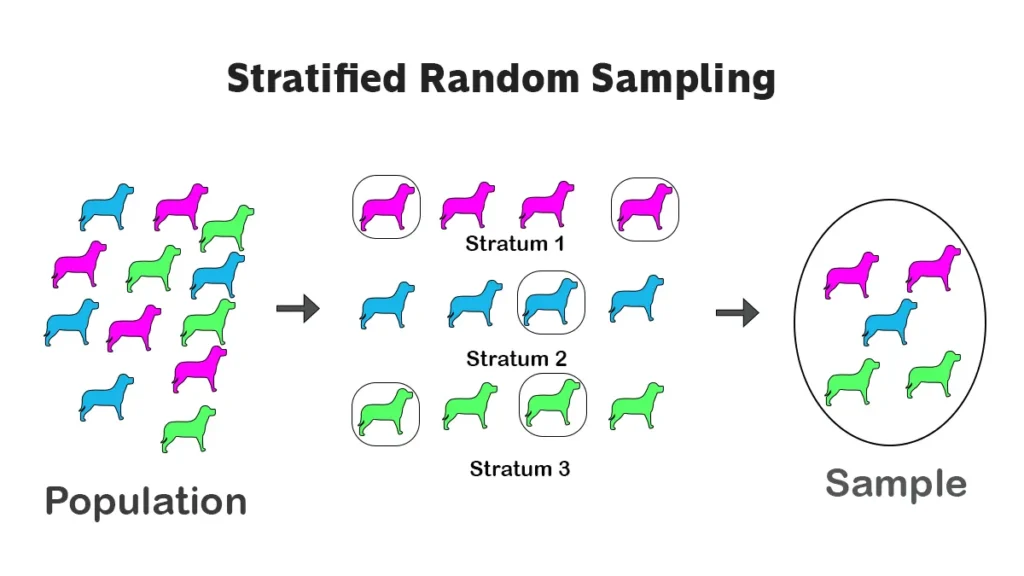
When studying different groups, a fair way to select participants is required. This is where examples of stratified random sampling is used. It splits your group into smaller parts based on what they have in common. Then, it picks people from each part fairly.
In this guide, I explain how this method works. You will see how it is used in real life, learn how to do it step by step, and find out when to use it.
Whether you are starting a big study or improving your current one, you will find useful tips in this book. I have made difficult ideas easy to follow because research tools should be for everyone.
Key Takeaways
- This technique makes sure all groups in your study are fairly represented.
- The method splits the population into clear parts before picking participants randomly from each.
- It helps reduce bias and makes your results more accurate than simple methods.
- It’s best when your population has clear, measurable traits that define the subgroups.
- It’s used in medical research, market studies, education, and social sciences.
- Knowing when to use this method will make your research stronger.
What Is Stratified Random Sampling
Stratified random sampling is key in studying groups. It sorts people into groups before picking them. This makes sure the sample is fair.
I use it to make sure all parts of the group are studied. It makes layers in your data before you start collecting answers.
Understanding the Fundamentals
It divides the whole group into smaller groups called strata. Then, it picks a random sample from each group.
This method is great for groups that are different but can be sorted. It’s like sorting people into groups before picking a sample.
It makes sure all parts of the group are included. Each group gets the right amount of attention based on its importance.
This method is different from simple random sampling. It sees groups within the population. These groups are important for the research.
The main idea is to keep randomness within structure. It organizes groups but picks randomly within each group.
Essential Elements That Make Stratification Work
Every good stratified sampling needs four key parts. Knowing these parts helps you use the method right.
The target population is who you want to study. This could be all customers, students, or any group for your research.
Next, you need stratification variables. These are the traits that divide your population. They should be important for your research and easy to spot.
| Component | Description | Example | Critical Requirement |
| Target Population | Complete group under study | All registered voters in a state | Clearly defined boundaries |
| Strata | Distinct subgroups within population | Age groups, income brackets | Mutually exclusive categories |
| Stratification Variables | Characteristics defining strata | Gender, education level, location | Relevant to research objectives |
| Random Selection | Sampling method within strata | Computer-generated random numbers | Equal probability for each member |
| Sample Size Allocation | Number of participants per stratum | Proportional or equal distribution | Adequate representation per group |
The third part is the strata themselves. They must be mutually exclusive and exhaustive. No one can be in more than one group, and everyone must be in a group.
Lastly, you need a way to pick people randomly in each group. This keeps the selection fair and gives everyone a chance.
How Population Strata Are Properly Defined
Defining strata means making groups that are similar within but different from others. Each group has people who share traits.
I pick variables based on what’s important for my research. Common ones include:
- Demographic factors like age, gender, or ethnicity
- Socioeconomic indicators such as income or education level
- Geographic location including region, urban versus rural, or zip code
- Behavioral patterns or usage frequencies
- Professional categories or industry classifications
The quality of your strata affects your results. Good strata reduce errors and make your estimates more accurate.
When making strata, make sure each group is big enough. A small group might not give reliable data, even with random selection.
Also, check if you have data for all your population before starting. You cannot sort by income if you do not have income data for everyone.
Good strata definition is flexible. You can sort by one or more variables. This is useful when your research needs it.
This sets the stage for using stratified random sampling well. Knowing about strata and how to define them is the first step to using this powerful method in your research.
When to Use Stratified Random Sampling in Research
Knowing when to use stratified sampling is key. However, this is not always the best choice. However, in some cases, it is vital to obtain accurate results.
Choose stratified sampling when it fits your project. It depends on your population and what you want to learn.
Ideal Research Scenarios
Stratified sampling is best when your population has clear groups. It helps when you need to compare different subgroups well.
In healthcare, it is beneficial to study patient outcomes by age or income. It makes sure each group is well-represented.
In schools, it’s useful for studying student performance by grade or background. It makes your research more accurate.
Market research teams use it to study different customer groups. It helps ensure all groups are included.
Population Characteristics That Benefit from Stratification
Some populations are better for stratification. Look for these key features:
- Clear demographic divisions like age, gender, or income
- Geographic distribution across different areas
- Behavioral patterns that create groups
- Measurable attributes for easy grouping
- Underrepresented minorities that might be missed
Populations with stable characteristics work best. If people easily move between groups, stratification is hard.
Find variables that are meaningful and stable. Without these, your sampling will not be representative.
Research Design Considerations
Before using stratified sampling, think about a few things. These factors help decide whether the extra work is worth it.
You need sufficient information about your population. This means knowing the key characteristics before sampling.
Also, consider your resources. Stratified methods need more planning and might cost more than simpler ones.
| Design Factor | Requirements | Impact on Results | Resource Needs |
| Population Knowledge | Complete demographic data and distribution information | Ensures accurate stratum formation and sample allocation | Time for preliminary analysis and data collection |
| Stratification Variables | Measurable, stable characteristics relevant to research questions | Improves precision and reduces sampling error | Statistical expertise for variable selection |
| Sample Size Planning | Adequate representation in each stratum for valid analysis | Enables meaningful subgroup comparisons | Larger overall sample may be needed |
| Implementation Capacity | Ability to sample separately from each stratum | Maintains sampling integrity and randomization | Additional staff time and coordination |
Your research goals should justify the extra effort. Choose stratified sampling if subgroup comparisons are key.
Make sure stratification variables are stable and measurable. If not, this method will not be helpful.
Think about your timeline. Stratified methods need more planning but can save time in analysis.
The final decision is based on your research needs. For diverse populations and precise subgroup estimates, stratified methods offer superior accuracy.
Types of Stratified Random Sampling
There are two main ways to do stratified random sampling. Each method is good for different research needs. I will explain both methods so that you can select the most appropriate one for your study.
The main difference is how you spread out your sample. This choice affects your study’s power and how accurate your results will be. Let’s look at each method closely.
Proportionate Stratified Sampling
Proportionate stratified sampling makes your sample match your population’s size. If 40% of your population is in one age group, your sample will also have 40% from that group. This way, all groups are well-represented.
This method is easy to follow. Just multiply your total sample size by each group’s share of the population. For example, if you need 500 samples and one group is 30% of the population, you’ll pick 150 samples from that group.
This proportional allocation in sampling is great for getting population-level estimates. Your results will show what your whole population is like. Use this when you want to describe the whole population well.
Proportional stratification techniques have many benefits. They’re easy to use and don’t need much adjusting during analysis. Your sample will naturally match your population’s structure without needing to weight the data.
Disproportionate Stratified Sampling
Disproportionate stratified sampling is different. You choose how many samples to take based on other factors, not just population size. You may take more samples from smaller but important groups or from groups with more variation.
This method is useful when studying small but important groups. Consider studying rare medical conditions or minority groups. Even if they are small, sufficient data from these groups are required.
Disproportionate stratification techniques are also helpful when comparing groups of different sizes. You provide each group with the same number of samples, regardless of size. This helps in comparing all groups.
This method is flexible but requires additional work. Weights must be used in the analysis to obtain accurate results. This is easy with statistical software, but it is something to remember.
Choosing the Right Type for Your Study
The key is what you want to learn from your study. I use proportionate stratified sampling for studies that aim to estimate the population parameters. This is beneficial for studies that describe the entire population.
Disproportionate stratified sampling is better for studies that compare groups. This method is useful for examining differences between groups.
Consider these factors when making a decision:
- Subgroup size variability: Large differences in group sizes favor disproportionate sampling
- Analysis requirements: You need enough samples from each group for comparisons
- Resource constraints: Proportional methods are simpler and need less analysis work
- Variance within strata: More variation in some groups might mean more samples from those groups
In addition, consider what is available. Proportional stratification techniques are simpler and save time. Disproportionate methods require careful weighting to obtain accurate results.
Most studies in education and market research use proportional sampling. However, studies in healthcare with rare conditions or small groups may require disproportionate sampling. The right choice depends on the research questions and the groups being studied.
| Criterion | Proportionate Sampling | Disproportionate Sampling |
| Sample Allocation | Mirrors population proportions exactly | Based on research needs and variance |
| Best Use Case | Population-level descriptive estimates | Subgroup comparisons and rare populations |
| Analysis Complexity | Simple, minimal weighting needed | Requires careful weighting adjustments |
| Statistical Power | Varies by natural subgroup size | Equal or optimized across all strata |
Consider your goals before selecting a method. The right choice will help you obtain meaningful results. Both methods are valid but serve different purposes.
How to Perform Stratified Random Sampling: Step-by-Step Process
I will show you how to perform stratified random sampling step by step. This method is divided into six easy steps. This helps in selecting a good sample and maintaining research accuracy.
Learning to perform stratified sampling is easy because it is systematic. Each step builds on the previous one. This makes it less likely to make mistakes, which is beneficial for complex groups.
Step 1: Define Your Target Population
First, you must know who or what you are studying. Be very clear about who is in your group. Do not be vague, as this may lead to errors.
For example, saying “college students in the United States” is better than just “students.” Add details, such as whether they are full-time or part-time students. The more specific you are, the easier it is to progress.
In addition, know how many people you are working with. If it is 500 or 50,000, it changes how you plan your sample. This first step is key to the rest of the process.
Step 2: Identify Stratification Variables
Choosing the right variables to divide a group is important. Select those that relate to your study and show differences in the group. This helps ensure that the sample is fair.
Selecting Relevant Variables
When selecting variables, ask yourself a few questions. Does this variable affect your study? Can you measure it? Will it improve your sample?
Select variables that are important for your study. Do not choose random ones. They will not help your study.
Ensure that you can divide your group into distinct groups. This cannot be done if you measure things after selecting your sample.
Common Stratification Criteria
Through experience, I have found some good criteria for dividing groups.
- Demographic factors: Age, gender, income, education, marital status, and ethnicity
- Geographic characteristics: Region, state, urban vs. rural, climate, and population density
- Organizational attributes: Company size, industry, department, job level, and years in business
- Behavioral patterns: How often they use something, their purchase history, how engaged they are, and how often they participate
- Performance metrics: How well they do in school, their sales, productivity, and quality
It is best to use two or three variables. Too many make it difficult to manage the sample. You want to ensure that your groups are different, not just a bunch of categories.
Step 3: Divide the Population into Strata
After selecting the variables, the group was divided into clear subgroups. Each subgroup should have similar characteristics to the others. This is the basis for your sampling plan.
Ensure that each person is in only one group. Your groups should cover everyone without overlap. This is important for ensuring that the sample is fair.
For example, if you divide by age, ensure that each age group is clear and does not overlap. It is important to carefully check the group definitions.
In addition, ensure that your groups are sufficiently large for analysis. The aim was to include groups that make up at least 5% of the total population. This can be changed based on your research needs.
Step 4: Determine Sample Size for Each Stratum
Next, we determined the number of people to be selected from each group. Two main methods can be used: proportional and optimal allocation.
Proportional Allocation Method
The proportional allocation method maintains the same ratio of people in each group. Use the following formula: n_h = (N_h / N) × n. Here, nh is the number of people in each group, N_h is the size of each group, N is the total population, and n is the total sample size.
For example, if 200 people are sampled from a group of 1,000 and one group has 400 people, 80 people are selected from that group. This method ensures that each group is fairly represented.
I like this method when the groups are similar. It is easy to use and does not require special adjustments during analysis. This is a big plus.
Optimal Allocation Method
The optimal allocation method considers the size and variation of each group. Use this when groups have different levels of variation in the study. The formula includes standard deviations: nh = n × (N_h × σh) / Σ(N_i × σi).
This method assigns more people to groups with more variation. If one group is very different and the other is not, you will sample more from the different group. This makes the study more precise.
However, the standard deviations must be known or guessed before starting. Pilot studies or past research can be used for this purpose. The extra work is worth better results.
| Allocation Method | Best Used When | Calculation Complexity | Statistical Efficiency |
| Proportional Allocation | Strata have similar variability; simple representation needed | Low – requires only population proportions | Good – better than simple random sampling |
| Optimal Allocation | Strata show different variability levels; maximum precision desired | Moderate – requires variance estimates | Excellent – minimizes variance for given sample size |
| Equal Allocation | Comparing strata directly; small strata need adequate representation | Very Low – same sample from each stratum | Fair – useful for specific analytical goals |
Step 5: Select Random Samples from Each Stratum
After determining the number of people to be selected, the actual selection process begins. Random sampling procedures were used for each group. This ensures that everyone in a group has an equal chance of being selected.
Random Selection Procedures
I used different random sampling procedures based on what I had. Random number generators are the easiest to use when you have a list of people. We randomly selected numbers that matched the list and chose the participants.
Systematic sampling is another effective method. A starting point was selected, and every nth person was selected. This works well with lists in the order.
For digital data, software such as R, SPSS, or Python can be used. These tools ensure that the sample is truly random. Always use a random seed for others to verify your work.
For small groups, drawing names from a hat is effective. However, for larger groups, computers are used. They are faster and more accurate, and they avoid bias.
Step 6: Combine Samples for Analysis
The final step is to combine all the groups into a single dataset. Ensure that you keep track of the group each person belongs to. This helps with the analysis and any necessary adjustments.
Create a variable in your dataset to show the group to which each person belongs. This is important for analysis and ensuring that the sample is fair.
If you used proportional allocation, your sample is already good. You do not need to adjust anything. This makes analysis easier.
If a different method is used, the data must be adjusted. Software was used to perform this analysis. This makes it easy and accurate.
Always document the entire process. Include everything from who you are studying to how you selected your sample. This makes the research clear and allows others to check the work.
Stratified Random Sampling Formula and Calculations
We explore how stratified sampling works. It is all about obtaining the correct number of samples from each group. Thus, our research is precise and reliable.
The formula for stratified sampling is easy to comprehend. I will show you how to use it with examples. It may seem difficult at first, but it becomes clear once you observe it in action.
Basic Formula for Sample Size Allocation
The first step is to determine the total number of samples required. The formula is as follows: n = (z²σ²) / e². This indicates the total number of samples in the study.
Let us examine each part of this formula. where z is the z-score based on the level of certainty. For a 95% confidence level, 1.96 was used
σ² is the population variance. It shows how spread out the data are. A higher variance indicates that more samples are required.
Where e is the margin of error. This is how much you are okay with your results being off. The common margins are ±3% or ±5%.
Here’s an example. Assuming that you want a 95% confidence level, your variance is 0.5, and you are okay with a 5% margin of error. Your calculation is n = (1.96² × 0.5²) / 0.05² = 384 samples.
Proportional Allocation Formula
After determining the total sample size, the number of samples to be taken from each group should be decided. The formula is as follows: n_h = (N_h / N) × n. This ensures that each group is fairly represented.
We now discuss what each part means. where nh is the number of samples in group h. N_h is the total population size of the group.
N is the total population size of the study. where n is the total sample size of the study. This formula keeps the sample in line with the population.
Here’s an example. Imagine that you have 10,000 people. One group comprised 3, 000 individuals. A total of 1, 000 samples were required.
The calculation is as follows: nh = (3,000 / 10,000) × 1,000 = 300 samples. Therefore, 300 samples were taken from that group. This matches 30% of the population.
| Stratum | Population Size (N_h) | Proportion | Sample Size (n_h) |
| Group A | 3,000 | 30% | 300 |
| Group B | 4,500 | 45% | 450 |
| Group C | 2,500 | 25% | 250 |
| Total | 10,000 | 100% | 1,000 |
Standard Error Calculation in Stratified Sampling
The standard error indicates the extent to which the sample may deviate from the true value. Stratified sampling provides a more precise standard error. This is a significant advantage of stratification.
The formula for the standard error considers the variance in each group. This is because different groups exhibit different levels of variation. By calculating separately, a more accurate measure of the sampling error is obtained.
The standard error also considers how large the sample is compared to the population. A larger sample in a group means fewer errors. This makes the estimates more reliable.
The calculation involved adding the standard errors from each group. Groups with more people had a greater impact on the overall error. This ensures that the error estimates match the population.
Variance Estimation
Variance estimation in stratified sampling uses a formula that demonstrates its precision advantage. The formula is as follows: Var(ȳst) = Σ(Wh² × σh² / nh). This calculation shows the variance that can be expected in the sample mean.
We will now break down these components. Wh is the stratum weight, which is N_ h/N. This shows the size of each group compared to the total population.
σh² is the variance within group h, and different groups may have different variances. A well-stratified population usually has lower variance within groups than across the entire population.
nh is the sample size of that group. A larger sample size from a group means less variance. This demonstrates the importance of choosing the appropriate sample size.
The summation symbol (Σ) indicates that the variances from each group are added. This gives the total variance of the sample mean. A lower total variance indicates more precise estimates.
These calculations show why stratified sampling often provides more precise estimates than simple random sampling. With well-defined groups and low internal variance, the mathematics works in your favor. Therefore, the results become more reliable.
Examples of Stratified Random Sampling: Real-World Applications
A real-world stratified sampling example demonstrates how this works. It is used in various fields. These examples can be used for your projects.
Each example shows how to select important groups. This helps us understand the different parts of a study.
Example 1: Educational Research Study
Universities use stratified sampling to study their students. Let us examine a study on graduation rates.
Scenario and Population Definition
One team studied college students’ GPAs across the U.S. They examined 50,000 students in their last two years.
They found different numbers of students in each major field. For example, there were 560 and 1, 135 in English and science, respectively.
This mix requires careful planning to obtain accurate results. Simple random sampling may overlook significant differences.
Stratification Process
The team used a two-dimensional stratification approach to achieve this. They divided students by university and their major.
This created groups like “University A – STEM majors.” They then selected a sample size for each group.
The team decided on the number of students to be included in each group. This ensured that everyone was fairly represented.
Sample Selection and Results
They randomly selected students from each group. This method ensured that every group was fairly represented.
The study found significant differences in GPAs between universities. This shows the importance of resources and teaching styles.
This example shows how stratified sampling helps identify important factors. This made the study 40% more accurate.
Example 2: Market Research Survey
Market researchers use stratified sampling to understand consumer behavior. We will now see how a product launch team used it.
Target Demographics
A company wanted to know what adults aged 18-65 thought about their product. They examined people from four U.S. regions.
They knew that preferences changed by region and income. This requires careful planning.
They had 500,000 people to choose from in their study. They wanted 2,000 surveys that would show the whole picture.
Strata Creation and Sampling
The team created 12 strata. They combined four regions with three income levels.
This method ensured that important groups were well-represented. Even though the Northeast accounted for only 18% of the population, it accounted for 25% of the sample.
They decided how many people would be included in each group. This ensured that every group had a say.
Example 3: Healthcare Population Study
Healthcare studies require precise methods. This example shows how to obtain reliable results.
Patient Population Stratification
One study examined 100,000 patients with chronic conditions. They were divided by age and diagnosis.
They divided patients into age groups. Each group exhibited different responses to treatment.
They then divided each age group according to the diagnosis. This resulted in nine groups that showed how age and diagnosis interacted.
Sample Allocation by Medical Conditions
The team allocated samples based on the efficacy of the treatments. Conditions with large differences had more samples.
Conditions with similar results had fewer samples. This makes the study more efficient.
They considered three factors when deciding on the sample size:
- Stratum size (number of patients in each category)
- Outcome variance (treatment response variability)
- Cost per observation (some tests required more expensive procedures)
Younger patients with heart issues accounted for 35% of the sample. Older patients with stable diabetes received a smaller share.
This method improved the efficiency of the study by 55 %. It found important treatment effects that were missed by simple random sampling.
Example 4: Employee Satisfaction Survey
Companies use stratified sampling to assess employee happiness. Let us examine how a large company has done this.
Department-Based Stratification
A company with 5,000 employees wanted to know what everyone thought of the company. They knew that different departments had different experiences.
They created groups for each department. Each department has its own culture and challenges.
They determined the size of each department. This helped them to plan the survey.
Ensuring Representative Coverage
The survey team used a proportionate allocation with minimum thresholds. Each department received a share based on its size, but small departments received at least 50.
This method made sure:
- Big departments gave detailed insights
- Small departments were heard too
- Every department was represented
- The study was reliable for all departments
They decided how many people would be included in each group. This ensured that everyone is voice was heard.
The sample allocation was as follows for the 600-person total sample:
- Human Resources (4%): 50 employees (elevated from 24 for validity)
- Sales (20%): 120 employees (proportionate)
- Operations (30%): 180 employees (proportionate)
- Information Technology (18%): 108 employees (proportionate)
- Finance (28%): 142 employees (proportionate after HR adjustment)
They randomly selected participants from each group. This ensured that the survey was fair.
The results provide insights for each department. The satisfaction scores ranged from 6.2 to 8.4. This indicates areas for improvement.
This method was effective because it matched the company’s structure. It captures real diversity and helps improve the workplace.
Stratified Sampling Calculator and Tools
Having the right tools for stratified sampling changes the research. Manual methods, statistical software, or online calculators can be used. Each option fits different needs and budgets of the consumers.
Good tools make systematic sampling easier and more efficient. They save time and reduce errors. Choose tools that match your research needs.
Manual Calculation Methods
Manual methods are suitable for small studies or learning the basics. I use Excel or Google Sheets to organize the data.
These tools show each step of the calculation. You can see how each decision was made. This helps you to better understand the process.
Manual methods help you learn the math behind sampling. You calculate the stratum proportions and sample sizes manually. Then, random numbers were used for selection.
I used Excel’s RAND() function for random numbers. Then, I sorted and selected cases based on sample size.
Statistical Software Options
Statistical software offers advanced features. It handles complex designs and analyzes data with stratifications. This is beyond the capabilities of manual methods.
Learning software takes time, but it saves a lot of work on large projects. You obtain tools for weighting and variance estimation.
SPSS and SAS Procedures
SPSS has a complex sample module for stratified designs. It allows you to define strata and automatically calculate weighted statistics.
SPSS easily handles allocation. You input the data, and it generates selection probabilities and weights for the analysis.
SAS has PROC SURVEYSELECT for design and PROC SURVEYMEANS for the analysis. It integrates the entire process from selection to analysis.
SAS simplifies complex formulas without the need for additional calculations. It provides selection probabilities, weights, and design effects.
R Programming Packages
R packages offer flexibility for those who prefer coding. You can customize your stratified sampling functions because R is an open-source software.
The sampling package has strata() for allocation purposes. You specify the variables and sizes, and R performs the random selection.
The survey package was used for complex designs and weighted analyses. This provides accurate standard errors and confidence intervals.
More packages extend these capabilities.
- stratification – optimizes stratum boundaries
- samplingbook – calculates sample sizes
- PracTools – finds optimal allocation under budget
- TeachingSampling – uses educational examples
These packages provide a complete toolkit for systematic sampling. You write scripts that document every step of the sampling process.
Online Calculators and Resources
Online calculators are quick for initial estimations. I use them for planning before using the full software.
Survey Lab is a versatile online tool for stratified sampling. It has advanced features, data analysis capabilities, and secure data handling.
Survey Lab allows users to customize surveys and integrate them with data systems. It is easy to use without the need for programming or software knowledge.
Many universities offer free online sample size calculators. These are great for planning and learning purposes.
I always double-check calculations for important projects, even when using online tools. This step detects errors and helps me understand the math.
| Tool Type | Best Use Case | Learning Curve | Cost Range |
| Manual/Spreadsheet | Small studies, learning fundamentals | Low | Free |
| SPSS/SAS | Large institutional research | Medium-High | $500-$8,000+ |
| R Packages | Custom analysis, reproducible research | Medium-High | Free |
| Online Calculators | Quick estimates, preliminary planning | Very Low | Free-$50/month |
Choosing the appropriate stratified sampling calculator depends on the project and skills. Start with simple and move to more complex tools as needed.
Stratified vs Simple Random Sampling vs Cluster Sampling
Choosing the appropriate sampling method can be challenging. However, I will explain when each one is best. Each method has its own application in research.
These methods are not only different. These serve different needs. Understanding these differences helps in selecting the most suitable approach for a project.
Stratified Sampling vs Simple Random Sampling
Stratified sampling focuses on different groups within a population. Simple random sampling selects individuals without considering their groups. This makes a significant difference in how the population is studied.
Simple random sampling can be thought of as picking names from a hat. Everyone has the same chance of being selected. It is good when the population is mostly the same.
Key Differences in Methodology
These methods function differently. Simple random sampling selects individuals from the entire group without prior sorting.
Stratified sampling requires more work. First, the population is sorted into groups. Then, individuals from each group were randomly selected.
This means that stratified sampling needs to know about the population’s groups before starting. You must know how to sort people first.
Precision and Efficiency Comparison
Stratified sampling is usually more precise than simple random sampling. This provides smaller standard errors and more accurate estimates. This is true when the groups are similar but differ from each other.
It is also more efficient because it ensures that all groups are represented. Simple random sampling may miss some groups. Stratified sampling avoids this by purposefully choosing groups.
However, simple random sampling is faster. It does not require as much planning or sorting. It is good for quick studies with similar populations.
Stratified Sampling vs Cluster Sampling
Stratified and cluster sampling differ in how they divide the population. Knowing when to use each of these methods is helpful.
Both methods divide the population into groups. However, they use these groups in different ways. This makes a significant difference in how the population is studied.
Structural Differences
Cluster sampling selects entire groups for study. For example, it might choose five schools and study all the students there. The groups themselves were the main units.
Stratified sampling ensures that every group is included. It selects people from all groups, ensuring that each group is represented. Each group contributed to the final sample.
The groups in cluster sampling should be different. Each group should resemble the entire population. In stratified sampling, the groups should be the same. The individuals in each group should be similar.
| Feature | Stratified Sampling | Simple Random Sampling | Cluster Sampling |
| Population Division | Divides into homogeneous strata | No division needed | Divides into heterogeneous clusters |
| Selection Process | Samples from every stratum | Samples from entire population | Samples entire clusters randomly |
| Precision Level | High precision with lower variance | Moderate precision | Lower precision, higher variance |
| Cost Efficiency | Moderate to high cost | Moderate cost | Lower cost for dispersed populations |
| Best Used When | Subgroup representation matters | Population is homogeneous | Geographic constraints exist |
Cost and Practicality Factors
Cost is a significant factor in choosing between cluster and stratified sampling. Cluster sampling is more effective when the population is dispersed. It is cheaper to study a few places than to visit everywhere.
For example, studying health clinics in a large area is cheaper with cluster sampling. It saves a lot of money on travel costs.
Stratified sampling is more expensive because it requires reaching every group. This implies more travel and planning. However, it provides better precision and fewer errors.
When to Choose Each Method
The choice of the appropriate method depends on the research. I have created a guide to assist you in making this decision.
Simple random sampling is chosen when:
- Your population seems mostly the same without big groups
- You don’t have enough info to sort groups well
- You need to work fast
- Money is tight and you can’t plan a complex design
Stratified sampling is chosen when:
- You really need to study different groups
- You know how to sort the population
- You want precise results and can plan ahead
- You want to compare different groups
Cluster sampling is chosen when:
- It’s hard to visit every place because of where they are
- The groups in your population already exist naturally
- Cost is a big issue and you need to save money
- The groups you have are diverse enough
Understanding the research goals is the key. Stratified sampling is the best method for studying groups. Cluster sampling is suitable for areas that are difficult to access. Simple random sampling is fast and simple to perform.
Carefully consider your population. If the data is diverse and can be sorted, stratified sampling is the best approach. If it is spread out, cluster sampling is better. If it is mostly the same, simple random sampling works well.
Additionally, consider your financial situation. Stratified sampling requires more work but yields better results. This choice often comes down to how much effort you can put in versus how precise your results need to be.
Advantages and Disadvantages of Stratified Random Sampling
The advantages and disadvantages of stratified random sampling are as follows. Knowing both aspects helps researchers decide whether a method is suitable for their research. Each method has its own trade-offs.
Key Advantages in Research Design
Stratified random sampling is ideal for serious research. It provides reliable data on specific groups. This is better than simpler methods.
Improved Precision and Representation
This method makes the samples more precise. You obtain smaller standard errors than simple random sampling. This is because it reduces the sample variability.
Your estimates for each group and the entire population improved. The margin of error decreases. This means that fewer participants are required than for other methods.
Minority groups are better represented by stratification. You will not miss out on the important parts of your population. All groups were included as planned.
Stratified sampling is ideal for comparing groups. You can trust your analysis because each group is well represented. This is key to studying minority groups or specific subgroups.
You can adjust the number of participants in each group. This allows you to focus on the most important groups. You will gain detailed insights into the groups that matter most.
Comparing groups becomes more meaningful. You will not have too few cases to draw valid conclusions. Each group had sufficient participants for a good analysis.
Limitations and Challenges
Stratified sampling has some disadvantages. These challenges require careful planning and resources. Knowing these factors helps avoid problems.
Complexity in Implementation
Stratified sampling is more complex than simple sampling methods. More planning and knowledge of the population are required. You must define the strata, calculate how many to include in each, and manage the sampling process.
The administrative burden increases with each stratum. You will need to manage separate sampling frames and maintain accurate records for each group. This can lead to errors.
Training your team becomes increasingly challenging. Everyone must understand the stratification system and follow it carefully. Mistakes can ruin your studies.
Information Requirements
You need accurate and complete information about your population before starting. Without the right data, this method cannot be used effectively.
The quality of the data is key. Bad data can ruin the benefits of stratification. You require up-to-date and reliable information.
Dealing with overlapping categories is difficult. You must have clear rules for who belongs to which group. These cases require careful handling to maintain valid strata.
Cost and Time Considerations
Stratified sampling can be more expensive and time-consuming than simpler sampling methods. It requires more time to plan and more resources for data collection and analysis.
The planning phase is a significant investment. You need to research your population, define the strata, and plan your sampling. This can take a long time before data collection begins.
But, the precision it offers can be worth it. In large research projects, obtaining accurate results is key. The upfront costs may be worth it for reliable results.
However, budget limits may prevent the use of stratified sampling. Small studies or exploratory research may not be worth the cost. You must weigh your resources against your research goals.
| Aspect | Advantages | Disadvantages | Impact Level |
| Precision | Smaller standard errors and more accurate population estimates | Requires larger initial investment in planning and resources | High |
| Subgroup Analysis | Ensures adequate representation of all important population segments | Increases complexity in data collection and management procedures | High |
| Implementation | Allows flexible allocation strategies tailored to research objectives | Demands detailed population information before sampling begins | Medium |
| Cost Efficiency | Reduces total sample size needed for desired precision level | Higher costs for planning, training, and administrative coordination | Medium |
| Applicability | Works exceptionally well for heterogeneous populations with clear subgroups | Becomes ineffective when stratification variables are poorly defined or unavailable | High |
Sample Size Determination for Stratified Sampling
Determining the appropriate sample size for stratified sampling is key. It balances the precision of the desired results with what is practical. Getting it right means that your research is reliable and does not waste money. The sample size affects the budget and the strength of the findings.
The research goals guide this calculation. If subgroups need to be compared closely, a larger sample size is required. This is different from studies that only want to know about the entire population.
Factors Affecting Sample Size
Many factors influence the size of the sample. The desired confidence level is usually 95% or 99%. This level affects the number of people required in the sample.
The margin of error you are okay with is also important. If you want your results to be very precise, you will need more people. I usually suggest starting with a 5% margin for most of the studies.
The variation in the population of each group is another significant factor. More varied populations require larger samples to capture this diversity. Pilot studies would be helpful in this regard.
The size of each group is also important. When groups are very different in size, you need to ensure that each group gets a fair share. This is where proportional methods are used.
What you want to achieve with your research also plays a role. If small groups need to be compared closely, enough people are required in each group. This is true even if the groups are of different sizes.
| Factor | Impact on Sample Size | Typical Values | Considerations |
| Confidence Level | Higher confidence = larger sample | 95% or 99% | Balance statistical rigor with resources |
| Margin of Error | Lower margin = larger sample | 3% to 5% | Tighter bounds increase costs significantly |
| Population Variability | Higher variance = larger sample | Determined by pilot data | Use conservative estimates when uncertain |
| Stratum Sizes | Affects allocation proportions | Varies by population | Ensure minimum samples in small strata |
| Effect Size | Smaller effects = larger sample | Determined by research goals | Consider practical significance versus statistical significance |
Allocation Methods and Formulas
There are different ways to allocate samples in stratified sampling. The right method depends on the goals, budget, and population. Each method has its own formula for determining the number of people sampled from each group.
Understanding these methods helps obtain the most precise results while keeping costs low. I have used all three methods, depending on the research needs.
Equal allocation gives the same number of samples to every group, regardless of its size. The formula is simple: nh = n/L, where n is the total sample size and L is the number of groups.
This method is effective when all groups are to be compared equally. It is used when comparing subgroups is key, and each comparison requires the same power.
It is also useful when costs and variability are similar across groups. This makes fieldwork easier because each group receives the same attention.
Proportional Allocation
Proportional allocation provides more samples to larger groups. The formula is as follows: nh = n(Nh/N). Here, Nh is the size of group h and N is the total population size.
This is my favorite method when you want your sample to reflect the population. This ensures that larger groups have more samples, creating a representative sample.
This method is used when groups have similar variability and you are estimating overall population parameters. The calculations are easy and simple to explain to others.
Neyman Allocation
Neyman allocation considers both group size and variability. The formula is nh = n(NhSh/ΣNhSh), where Sh is the standard deviation of group h.
This method makes the overall estimate more precise. It is great when groups have different variabilities, and you have data on those differences.
I recommend Neyman allocation when precision is the top priority. You will need data from pilot studies or previous research to estimate the standard deviation for each group. The extra work is worth more efficient sampling.
| Allocation Method | Formula | Best Used When | Advantages |
| Equal Allocation | nh = n/L | Comparing all strata with equal precision | Simple implementation, equal comparison power |
| Proportional Allocation | nh = n(Nh/N) | Estimating population parameters, similar variability | Representative sample, straightforward calculation |
| Neyman Allocation | nh = n(NhSh/ΣNhSh) | Minimizing variance, different stratum variabilities | Maximum statistical efficiency, lowest variance |
Power Analysis Considerations
Power analysis is key to ensuring that the sample size is appropriate. It is about finding a real effect when it is present. Most studies aim for 80% power, but some might require 90% or more.
I calculate the power to detect real differences between groups. This includes considering expected effect sizes, significance levels, and how you allocate samples. Larger effect sizes need smaller samples, while small differences require more people.
The method you choose affects power differently for different comparisons. Equal allocation is best for comparing groups. Neyman allocation is better for overall population estimates.
Conduct a power analysis before deciding on the sample size. Tools such as G*Power or statistical software can help determine the correct sizes for hypotheses. This planning prevents studies that are too small and waste resources without providing clear results.
Common Mistakes and Best Practices
Knowing where things go wrong in stratification can save a research project. I have examined hundreds of studies. The same common stratification errors continue to appear. However, these mistakes can be avoided if you know what to watch for.
Learning from others’ mistakes is easier than making them yourself. This section presents the best practices for stratified sampling. This will help you avoid mistakes that can ruin your research.
Errors to Avoid in Stratification
The key to good stratified sampling is to avoid basic mistakes. These errors can lead to biased results and render the research invalid.
Improper Strata Definition
An improper strata definition is a significant mistake. This occurs when researchers select the wrong variables for their study.
I have seen studies where incorrect variables were used. For example, using hair color in a study on education does not make sense. Your variables should relate to what you are studying.
It is also important to ensure that each person fits into only one stratum. If someone can belong to more than one group, your sampling plan fails.
Choosing the wrong variables is only the beginning. Some studies had too many strata, while others had too few. Finding the correct number depends on the study and population.
Inadequate Sample Sizes
Inadequate sample sizes in each stratum can ruin a study. I have seen studies with enough total samples but not enough in each stratum. This is insufficient for good statistics.
This mistake often occurs when only the total sample size is considered. Remember to check the size of each stratum. If some are too small, they will not be useful.
Before starting, the minimum sample size for each stratum was calculated. Consider the tests you will use and the sizes you need to find. Some strata may require more samples, such as for subgroup comparisons.
| Common Error | Why It Happens | Correct Approach |
| Irrelevant stratification variables | Choosing convenient variables | Choose variables linked to outcomes |
| Overlapping strata | Unclear definitions | Create clear, exclusive categories |
| Too few observations per stratum | Focusing on total size | Calculate minimum for each stratum |
| Ignoring proportionality | Equal allocation without reason | Match sample to population unless different goals |
Tips for Successful Implementation
Avoiding mistakes is insufficient. Using the best practices in stratified sampling ensures that the research is accurate and reliable.
Pre-Planning and Documentation
Pre-planning documentation is the key to success. I make detailed plans before starting. These plans explain every decision I made.
Your plan should include the following:
- Clear definitions of all stratification variables
- Why you chose these variables
- How you’ll allocate samples
- Expected sample sizes for each stratum
- How you’ll randomly select within strata
Maintain detailed records. This will help others understand your work. It also helps in writing the Methods section.
Quality Control Measures
Therefore, strong quality control measures are essential. I check my population data before starting the analysis. Old data can lead to incorrect strata.
Each person should fit into only one stratum. Check for any cases that do not fit or could fit multiple categories. These need clear rules.
Watch the response rates by stratum during data collection. If some strata have low rates, check the reason. You may need to change your approach.
A final check was performed after data collection. Compare your actual sample with your planned sample. Significant differences indicate problems that may require resolution.
Ensuring Representative Sample Selection
Creating a representative sample requires careful attention. Random methods were used within each stratum. Convenience sampling defeats the purpose of stratified sampling.
I used random number generators or systematic sampling. Do not select the easiest cases. This introduces bias.
We monitored non-response bias. If some strata have low response rates, the sample will not be representative. Determine the reasons and attempt to improve participation.
Consider using replacement sampling or oversampling for hard-to-reach strata populations. If you know that some groups will not respond, plan for more cases.
Maintain detailed records of sampling. Please include the number of cases you contacted, response rates, and any changes. This indicates the quality of the sample.
Conclusion
I have shown you how examples of stratified random sampling works in many fields. This helps obtain accurate results for different groups.
Doing well with Stratified sampling entails selecting the appropriate variables. Ensure that your random picks are fair in each group. This strengthens your research.
This method is suitable for many types of studies. If you are new, start with a small test. This helps you improve.
Maintain good records of your work. This includes how you chose your groups and selected samples. This will help others understand your study.
Stratified sampling requires more effort, but it is worth it. This makes the results more accurate. You can now use it in your next project.
Use what you have learned carefully. Your data will show how well you planned and selected your samples.
FAQ
What is the main difference between stratified random sampling and simple random sampling?
Simple random sampling treats all individuals equally. Stratified random sampling divides individuals into groups based on shared traits. It is like drawing from different hats.
Stratified sampling is more precise than random sampling. This ensures that each group is well represented. This makes the estimates more accurate.
How do I determine the right number of strata for my research?
Choose strata based on your research goals and population division. Start by identifying the key traits that affect your study. Each stratum should have at least 30-50 people for a reliable analysis. An excessive number of strata can complicate the analysis. Focus on the variables that matter most to your study. Balance precision with practical limits, such as cost and time.
Can I use stratified random sampling if I do not have complete information about my population?
No, complete information is required for stratified sampling. If people cannot be classified, this method will not work. You may conduct a preliminary survey or use existing data. Other methods, such as cluster sampling, should also be considered. Even with limited data, geographic location can be used for stratification.
What is the minimum sample size required for each stratum?
Aim for 30-50 observations per stratum for reliable analysis. This ensures that important differences can be detected. The exact minimum depends on the study goals and data variability. Aim for larger samples in critical subgroups. Power analysis was used to determine the sample size for each stratum.
Should I use proportionate or disproportionate stratified sampling?
Choose based on your research objectives. Proportionate sampling mirrors the population for generalization. Disproportionate sampling is used for subgroup comparisons or when certain groups are small but important. It requires weighted analysis.
How does stratified sampling improve precision compared with simple random sampling?
Stratified sampling reduces the overall sample variability. This creates homogeneous groups within the population. This leads to smaller standard errors and more precise estimates of the parameters. It is more precise when the strata are very different from each other.
What software tools are recommended for conducting stratified random sampling?
For simple projects, use Excel or Google Sheets to manage your data. They help to organize data and calculate sample sizes. For complex analysis, try ECORSTATS, SPSS, SAS or R packages. They handled stratified sampling and weighted analysis well. Online calculators are useful for quick calculations, but they should always be double-checked manually.


[…] Stratified Random Sampling […]
[…] Stratified Random Sampling […]